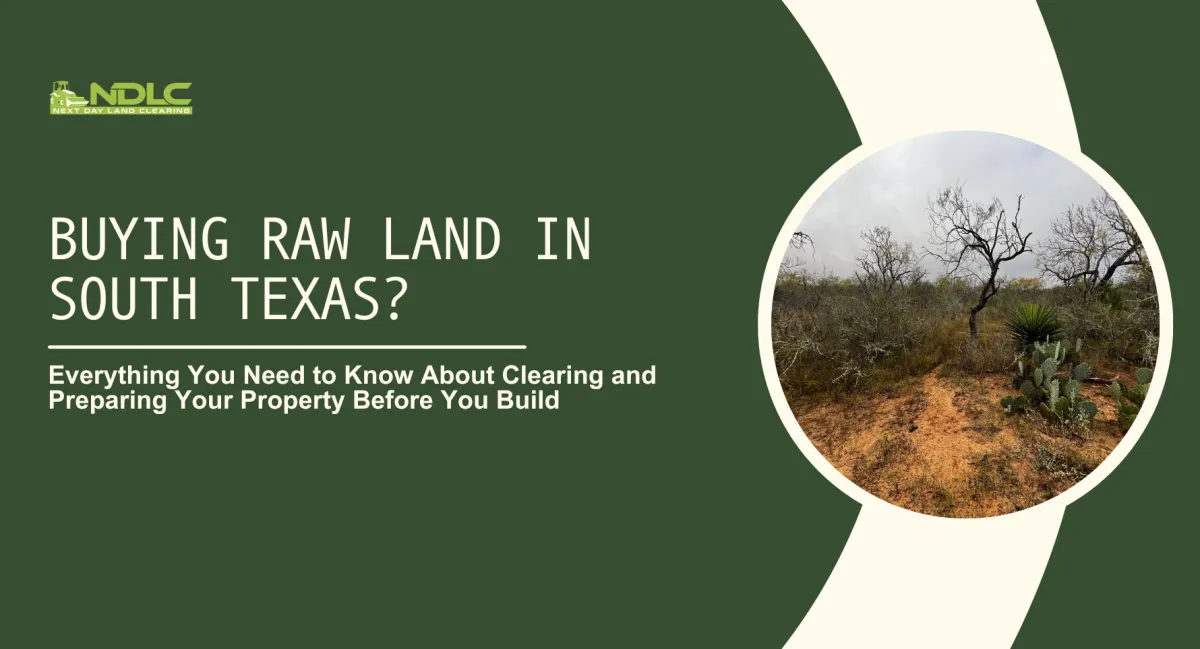
Buying Raw Land in South Texas?
Buying raw land in South Texas is one of the most exciting purchases a person can make. Whether the plan is a custom home, a ranch retreat, a small farm, or an investment you intend to develop over time, raw acreage in this region offers something that finished lots cannot: the freedom to build exactly what you want on your terms.
But raw land comes with a reality that first-time buyers often underestimate. Between the day you close on the property and the day a foundation gets poured, there is a significant amount of work to be done. The brush has to be cleared. The terrain has to be graded. Rock and caliche have to be addressed. Utilities have to be brought in. Access has to be established.
None of that is a reason to hesitate. It is just information worth having before you get started so you can plan properly, budget accurately, and move your project forward without the costly surprises that catch unprepared landowners off guard.
This guide covers everything a new South Texas land buyer needs to know about clearing and preparing raw property before construction begins.
What Makes South Texas Raw Land Different
Raw land anywhere requires preparation before building. But South Texas has a specific combination of terrain, vegetation, and soil conditions that shape what that preparation looks like and how much it costs.
The Vegetation
Cedar, mesquite, prickly pear, and mixed brush dominate undeveloped land across much of the region. Depending on how long a property has been unmanaged, this vegetation can be light enough to walk through or so dense that you cannot see across a ten-acre lot. Cedar in particular spreads aggressively and is one of the most persistent land management challenges in South Texas.
Clearing this vegetation is almost always the first major task on a raw land project. The good news is that modern equipment handles it efficiently. Forestry mulching is the most common approach for South Texas brush clearing because it grinds vegetation in place without requiring hauling, leaves a mulch layer that helps with erosion control, and works across the uneven and rocky terrain that characterizes much of the region.
The Soil and Rock
Caliche is one of the defining features of South Texas soil. It is a calcium carbonate layer that forms a hard crust below the surface, anywhere from a few inches to a foot or more down. Caliche affects drainage, makes excavation harder, and can complicate foundation work if it is not properly addressed during site prep.
Limestone and other rock formations are also common, particularly in the Hill Country transition zones north and west of San Antonio. On some properties, rock crushing services are a necessary part of site preparation before grading and foundation work can proceed.
Neither caliche nor rock is a dealbreaker. They are just factors to understand before you buy and before you budget.
The Climate
South Texas summers are long, hot, and punctuated by intense rain events that can dump several inches in a short period. Dry months cause soil to shift and crack. Wet months test drainage systems and expose poorly prepared sites to erosion.
A site that is properly cleared, graded, and drained handles both conditions without problems. A site that is not properly prepared can develop issues during the first rain event that cost far more to fix than they would have to prevent.
Step One: Know What You Are Buying Before You Close
The most expensive mistakes in raw land development happen before a shovel hits the ground. Buyers who purchase without a clear picture of what they are working with frequently encounter surprises during site prep that push their budgets well beyond what they planned.
Before you finalize a land purchase, try to get answers to the following:
What Is the Vegetation Situation?
Walk the property if at all possible. What looks clear from a road or aerial image can be thick brush up close. Know whether the land is lightly vegetated or whether it requires heavy clearing before anything else can happen. The difference between a light brush clearing job and a full cedar and mesquite removal on a 10-acre property can be substantial in both cost and timeline.
Is There Rock?
Talk to neighbors. Ask your real estate agent. If anyone has done work on adjacent properties, find out what was below the surface. Some parcels in South Texas grade easily. Others hit solid limestone or deep caliche that requires rock crushing before grading can proceed. Knowing this before you buy helps you budget accurately and choose the right contractor.
How Does the Land Drain?
Look at the topography. Are there low spots that collect water? Does the natural grade drain toward the area where you plan to build? South Texas rain comes fast and heavy. A site with poor natural drainage or one that sits in a low-lying area relative to neighboring properties can require significant grading work to make it functional.
Where Are the Utilities?
Raw land often has no utilities at the property line. Electric, water, gas, and communication lines may need to be run from a road or neighboring connection point. Trenching contractors South Texas teams handle this work, but the cost and complexity depend on how far the utilities are and what the terrain between here and there looks like. Get this information before you close.
What Do the Permits Require?
Permitting requirements for land clearing, grading, and construction vary by county and municipality across South Texas. Some jurisdictions require permits for grading above certain acreage thresholds. Others have specific requirements for septic systems, setbacks, and utility connections. Know what applies to your parcel before you start planning.
The Clearing Process: What Happens First
Once you own the land, clearing is almost always the first physical step. You cannot assess, grade, or plan a build site you cannot see. Clearing opens the property up, gives you a true picture of the terrain, and establishes the foundation for everything that follows.
Forestry Mulching
For most South Texas raw land projects, forestry mulching is the most practical clearing method. A forestry mulcher is a tracked or wheeled machine that grinds brush and trees directly on site, leaving a layer of mulch rather than debris piles that need to be hauled off.
The advantages for raw land buyers are significant:
Efficient across large acreage and dense brush
No debris hauling required, which reduces cost and keeps the site clean
Works across rocky and uneven terrain
Mulch layer helps control erosion during the construction phase
Faster than traditional cut-and-haul methods on most South Texas terrain
Forestry mulching South Texas operations are well matched to the region because the equipment is purpose-built for exactly the type of brush that grows here. For cedar removal, mesquite management, and mixed brush clearing on properties ranging from a few acres to hundreds, it is typically the first tool to reach for.
Tree Removal
Larger trees require individual attention. If your property has significant trees that need to come down within your building footprint, tree removal South Texas contractors use a combination of cutting and stump removal to clear the area properly.
If there are trees on or near your property you want to preserve, mark them clearly before any equipment arrives. Once a mature tree is down, it cannot be replaced on a reasonable timeline.
Fence Line Clearing
Many South Texas properties come with fence lines that have not been maintained in years. Before you can establish your boundaries clearly, move equipment efficiently, or assess the perimeter of what you own, fence line clearing services restore visibility and access around your property edge.
This is often completed early in the clearing process because it defines the working area and allows equipment to move around the full perimeter without obstruction.
Stump Removal
After trees are down, stumps and root masses that are left in place create ongoing problems. They obstruct grading equipment, send up new shoots that require repeated clearing, and become harborage for insects. Stump removal services address this at the source so your cleared area stays clear.
Understanding Caliche and Rock on Your Property
This is where a lot of first-time raw land buyers encounter their biggest unexpected costs. Rock and caliche management is a normal part of South Texas site preparation, but it is not always visible until clearing begins.
What Caliche Does to Your Site
Caliche layers affect your project in a few important ways. They can make excavation for foundations, utilities, and septic systems significantly harder and more equipment-intensive. They affect drainage by creating a barrier that water cannot pass through easily, which can cause pooling above the caliche layer during heavy rain events. And they can create an unstable sub-base for roads and driveways if not properly addressed.
The right approach depends on the depth and density of the caliche on your specific parcel. In some cases, caliche can be worked into the site as useful base material after it is crushed. Rock crushing San Antonio and South Texas contractors use specialized equipment to grind caliche and limestone in place, turning what would otherwise be an obstacle into usable base material for driveways, parking areas, and building pads.
When Rock Crushing Is Needed
Rock crushing services become necessary when clearing and grading equipment encounters subsurface material it cannot move through conventional means. If your site has significant rock, your site preparation contractor needs to have rock crushing capability in house or through a reliable subcontractor they can mobilize quickly.
Ask about this before you hire anyone. A contractor who cannot crush rock on site will have to haul it off, which costs significantly more in both equipment and disposal fees. The best site work specialists bring rock crushing capability as part of their standard scope so your project does not stop and wait while someone else gets scheduled.
Land Grading: Turning Cleared Land Into a Build-Ready Site
Once clearing is complete, grading begins. This is the phase that shapes your raw land into a site that can actually support a structure, a road, a septic system, and everything else your finished property needs.
What Land Grading Accomplishes
Land grading services do several things simultaneously. They establish the elevation and slope of your building pad so that your foundation sits at the correct height. They shape the surrounding terrain so that water drains away from your structure rather than toward it. They compact fill material so that the ground under your foundation is stable. And they create a consistent, workable surface for the construction phase that follows.
For raw land buyers, grading is often the most underestimated part of site prep in terms of both cost and importance. A building pad that is not properly graded and compacted will settle unevenly. A site that does not drain correctly will create foundation problems, erosion, and standing water that affects every structure on the property.
Drainage Is Not Negotiable
South Texas gets its precipitation in intense bursts. When four inches of rain falls in two hours, every drainage decision you made during site prep gets tested at once. Properties that were graded with drainage as a priority handle these events without significant damage. Properties that were not tend to develop erosion channels, silted driveways, and foundation moisture issues that are expensive to address after the fact.
Before grading begins, make sure your contractor understands where water needs to go and how the grade of your site will direct it there. If you have a civil engineer or architect involved in the project, make sure their drainage plan is reflected in the grading scope before work starts.
Building Pad Preparation
Your building pad is the area of compacted, graded ground where your foundation will be placed. Getting this right means establishing the correct elevation, achieving the compaction density your foundation engineer specifies, and creating a stable, level surface that will not shift over time.
For mobile home site preparation, the requirements are specific to the home type and local standards. A modular or manufactured home that is set on a poorly prepared pad will show problems quickly, from uneven settling to utility connection issues. Whether you are building a custom home or setting a manufactured home, the pad work deserves the same attention.
Infrastructure: Getting Utilities and Access in Place
A cleared and graded site is not yet a functional property. Before construction can begin, the infrastructure that makes the site livable and workable has to be put in place.
Driveway Preparation
Access is fundamental. Before construction equipment, delivery trucks, and eventually your family can use the property, a stable access route has to be established. Driveway preparation services create a compacted, properly graded road surface that handles the weight of construction traffic and holds up through the rain and heat cycles that South Texas delivers.
If caliche or rock is available on site after crushing, it often makes excellent driveway base material. A contractor who handles both rock crushing and driveway prep can use what is already there rather than importing material, which saves money and keeps the project moving.
Utility Trenching
Water, electric, gas, and communication lines all require trenches. Trenching contractors South Texas teams cut to the specifications your utility providers require, properly bed the lines, and backfill and compact the trench so the surface is stable above it.
Utility trenching should be coordinated with your providers early in the process. Inspections at specific stages are common and need to be scheduled ahead of time so the project does not sit waiting for an inspector to become available.
Retaining Walls
Properties with significant grade changes between the building area and surrounding terrain often need retaining wall installation to manage those transitions. Retaining walls prevent erosion, define usable outdoor areas, and stabilize slopes that would otherwise shift over time. On South Texas properties with hillside terrain or significant cut-and-fill work, engineered retaining walls are part of the site prep scope from the start.
Budgeting for Site Prep: What First-Time Buyers Need to Know
One of the most common frustrations for first-time raw land buyers is discovering that their site preparation costs were significantly higher than they expected. This usually happens for one of a few reasons: they did not walk the land before buying, they did not ask the right questions about rock and drainage, or they received a clearing quote that did not include grading, utilities, and access work.
Clearing
Costs vary based on vegetation density, acreage, and the specific methods required. Forestry mulching is typically priced per acre and depends on how thick the brush is and what terrain the equipment has to navigate. Get a quote that specifies what is included and what the scope covers.
Rock and Caliche Work
If rock crushing is needed, it adds cost but often saves money on material disposal compared to hauling rock off site. Ask your contractor whether crushed material will be reused on the property or removed, and how that affects the overall price.
Grading and Drainage
Land grading is typically priced based on the scope of work: how much material needs to move, how far it needs to move, and what drainage corrections need to be made. Complex sites with significant elevation change or drainage challenges cost more than relatively flat sites with simple grading needs.
Utilities and Access
Driveway preparation and trenching costs depend on distance, terrain, and the depth requirements for each utility type. Get utility location information before budgeting so you are not estimating based on best-case assumptions.
The Cost of Not Doing It Right
Every site prep shortcut creates a downstream cost that is almost always larger than what would have been saved. Foundation settlement from poorly compacted fill. Erosion from inadequate drainage. Road failure from unprepared base. These are not hypothetical risks. They are common outcomes when site preparation is rushed or underpriced. Affordable land clearing services means fair pricing for quality work, not the lowest number that still lets someone turn a profit.
Choosing the Right Site Prep Contractor
Not every land clearing company in South Texas is set up to handle a full raw land development project from brush to build-ready. When you are evaluating contractors, here is what to look for:
Full-scope capability: Can they handle clearing, rock crushing, grading, driveway prep, and trenching, or will you be managing multiple separate contractors for the same project?
Regional experience: South Texas terrain, caliche, and brush require contractors who have worked here, not operators who are learning on your job
Equipment on site: Contractors who own their equipment and keep it maintained move faster and have fewer delays than those who rent or borrow for each job
Fast, transparent quoting: A professional contractor should be able to give you a clear, detailed quote quickly, not a vague estimate that leaves room for surprises
References from similar projects: Ask specifically about raw land clearing and site preparation work, not just residential brush clearing
The Next Day Difference means a site preparation contractor who can quote your project in about 5 minutes, schedule quickly, and bring the full range of equipment needed to take your raw land from overgrown acreage to a build-ready site. For new landowners who are ready to move but do not want to wait weeks just to get started, that responsiveness is not a bonus. It is the whole point.
A New Landowner Checklist: Before You Break Ground
Before equipment rolls onto your raw land, confirm the following:
Survey completed and property boundaries clearly marked
Utility locates called in and marked on site
Vegetation and tree preservation areas identified and flagged
Clearing scope reviewed with your contractor including what method will be used and what is included
Rock and caliche conditions discussed with your contractor before work begins
Grading plan and drainage plan reviewed and agreed upon
Building pad elevation confirmed with your foundation engineer or architect
Utility trench routes identified and coordinated with providers
Driveway alignment and base requirements confirmed
Permits pulled for any work that requires them in your jurisdiction
Working through this checklist before clearing begins eliminates the most common causes of raw land development delays and budget overruns.
From Raw Land to Ready: What the Process Looks Like
Every raw land project is different, but the general sequence for a South Texas property runs something like this:
Boundary confirmation and utility locates: Before any equipment moves
Fence line clearing: Establishes the perimeter and allows equipment access around the full property
Brush and vegetation clearing: Forestry mulching, cedar removal, and general clearing of the build footprint and access areas
Tree removal and stump grinding: Individual large trees and root mass removal
Rock crushing if needed: Processes subsurface rock and caliche into usable material
Rough grading: Moves material to establish general elevations and drainage slopes
Building pad preparation: Compaction and final elevation work for the foundation area
Utility trenching: Water, electric, gas, and communication runs
Driveway and access route preparation: Stable, compacted surface for construction and long-term use
Final grading and drainage: Finish work on slopes, channels, and surrounding areas
A contractor who can handle most or all of this scope keeps your timeline tight and eliminates the coordination overhead of managing multiple separate vendors for the same project.
Ready to take the next step? Call us today at 210-864-8342 for a FREE estimate and let's discuss your project! Visit Nextdaylandclearing.com for information.
