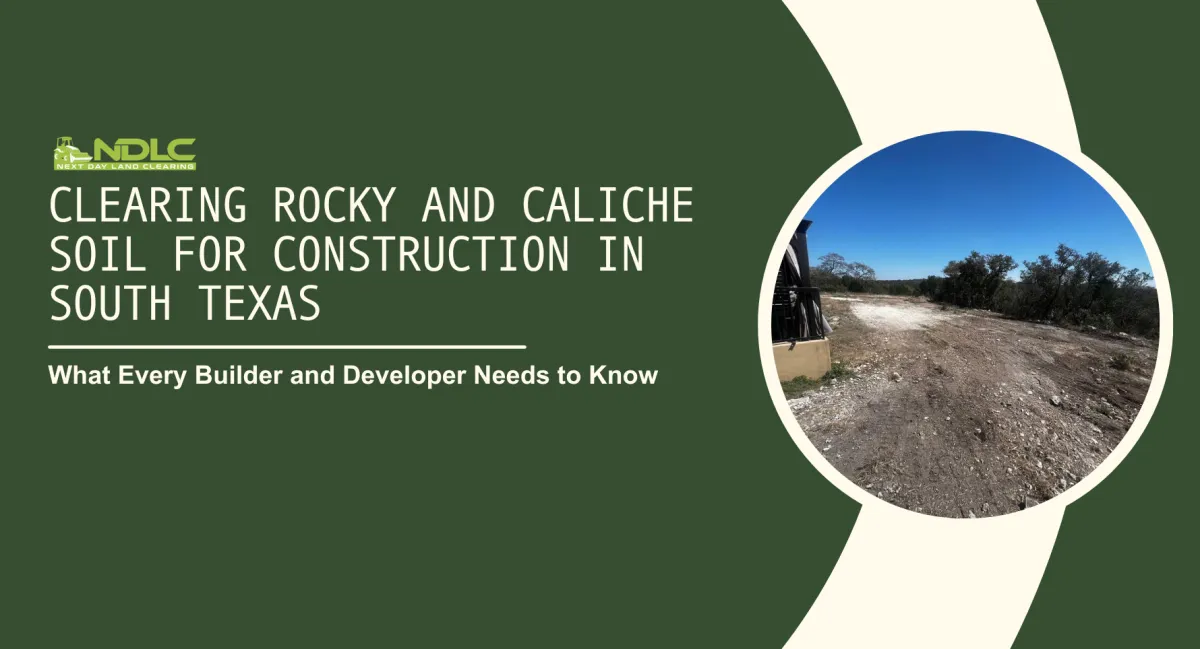
Clearing Rocky and Caliche Soil for Construction in South Texas
f you have ever tried to break ground on a South Texas property, you already know the feeling. The survey looks clean, the plans are approved, and then the excavator hits rock. Not soft, workable dirt, but dense limestone, stubborn caliche, and buried boulders that stop a project cold. For landowners, developers, and builders across the region, rocky soil is not an occasional surprise. It is the defining challenge of site preparation.
The good news is that rocky ground does not have to derail your timeline or blow your budget. With the right equipment, the right approach, and an experienced crew, even the hardest South Texas terrain can be cleared, crushed, and made build-ready. This guide walks through why the soil here is so difficult, what rock crushing actually does, how it compares to hauling rock offsite, and how to plan a site preparation project that stays on schedule.
Why South Texas Ground Fights Back
The land across San Antonio and the surrounding Hill Country sits on top of some of the most construction-resistant geology in the state. Much of the region is underlain by limestone bedrock, and closer to the surface you find caliche, a hardened layer of calcium carbonate that can be nearly as tough as concrete. Add in the scattered rock, cobble, and buried stone that show up almost everywhere, and you have ground that resists standard digging equipment at nearly every turn.
Caliche is especially frustrating because it is unpredictable. In one corner of a lot it might sit two feet down as a thin crust. In another it forms a solid shelf several feet thick. A crew that is not prepared for it can burn through hours, fuel, and equipment wear before making any real progress. This is exactly why so many projects stall the moment excavation begins.
Understanding what is under your property matters because it drives every decision that follows. The type of foundation you can pour, the way you route a driveway, where you set utilities, and how you grade for drainage all depend on how the rock is handled first. Getting this stage right is the difference between a smooth build and a series of expensive delays.
The soil conditions here also shift over short distances. Two properties on the same road can present completely different challenges, and even a single lot can change character from one end to the other. That variability is why generic estimates so often miss the mark. A price built on the assumption of soft, diggable dirt falls apart the moment a crew meets a caliche shelf that was never accounted for. Landowners who have been burned by a low bid that ballooned mid-project usually learned this lesson the hard way.
There is also a timing element that many first-time builders overlook. Rock does not care about your permit expiration, your loan draw schedule, or the crew you already booked for framing. When excavation stalls on unexpected stone, every downstream trade backs up behind it. Handling the ground properly and early keeps the entire chain of construction on track.
Common rocky-soil obstacles on a South Texas site include:
Thick caliche shelves that stop conventional excavators and trenchers
Surface and subsurface limestone that must be broken before grading
Loose rock and cobble that make compaction and leveling difficult
Buried boulders that surface only once digging begins
Uneven bedrock that complicates foundation and utility work
What Rock Crushing Actually Does
Rock crushing is the process of breaking down rock, caliche, and stone directly on your property and grinding it into smaller, usable material. Instead of hauling massive volumes of stone offsite, specialized equipment reduces the rock in place, turning an obstacle into something you can actually build on.
The result is a graded, compactable surface made from the very material that was blocking your project. Crushed rock and caliche create an excellent base for driveways, building pads, roads, and slabs. Rather than fighting the ground, you put it to work.
This approach solves several problems at once. It clears the rock, produces a stable foundation layer, and eliminates the enormous cost and hassle of trucking material away. For rocky lots across South Texas, on-site rock crushing services are often the single most efficient way to move from raw land to a build-ready site.
The benefits of crushing rock on-site include:
A ready-made, compactable base for pads, driveways, and roads
Far fewer truckloads of material hauled in or out
Lower overall project cost compared to import and export of fill
Reduced wear and tear on local roads and less site disruption
A faster path from cleared ground to construction
Crushing On-Site Versus Hauling Rock Away
When a site is full of rock, there are really two paths forward. You can excavate the stone and haul it offsite, then bring in fill and base material to rebuild the surface. Or you can crush the rock where it sits and use it as your base. On most South Texas projects, the second approach wins on cost, speed, and simplicity.
Hauling rock away is deceptively expensive. Every boulder and every yard of caliche has to be dug out, loaded, trucked to a disposal site, and paid for by the load. Then you turn around and purchase base material, which is trucked back in and paid for again. You are effectively paying twice, once to remove and once to replace, while adding days of truck traffic to the schedule.
Crushing the material in place flips that equation. The rock that was a liability becomes your building base. There is no disposal fee, no imported fill, and dramatically less trucking. For developers watching a budget and a calendar, that difference adds up quickly across an entire site.
Consider what hauling really involves on a rocky lot. A single site can produce hundreds of tons of rock and caliche once excavation gets going. Each truckload has to be loaded, driven to a facility that will accept it, and dumped for a fee. Multiply that across a full property and the disposal cost alone can rival the price of the crushing work itself, before you have spent a dollar on the replacement base you still need.
There is a hidden cost to all that trucking as well. Heavy loads coming and going tear up access roads, track mud and debris onto public streets, and create days of noise and congestion around the site. On developments near existing homes or businesses, that disruption can strain relationships with neighbors and even draw complaints. Crushing in place keeps the material and the mess contained to your own property.
There are situations where some material still needs to leave a property, and an experienced site work crew will tell you honestly when that is the case. The goal is never to force one method. It is to choose the approach that gets you to a solid, build-ready surface for the least cost and the least delay.
Where Crushed Rock and Caliche Really Shine
Once rock is crushed and graded, it becomes one of the most versatile materials on a construction site. Its strength and drainage make it ideal for the parts of a project that carry weight and take abuse. Knowing where crushed material performs best helps you plan a site that lasts.
Driveways and Access Roads
A properly crushed and compacted caliche or rock base is the backbone of a durable driveway. It handles heavy vehicles, sheds water, and resists the rutting that destroys softer surfaces. For rural properties with long approaches, driveway preparation over a crushed base is far more reliable than laying gravel over untreated dirt.
Building Pads and Slabs
A stable pad is the foundation of everything above it. Crushed rock compacts into a firm, level base that supports slabs for homes, barns, shops, and commercial structures. In a region where soil movement is a real concern, a well-built rock base helps protect against the settling and cracking that plague foundations poured on poorly prepared ground.
Roads and Heavy-Traffic Areas
Interior roads, parking areas, and equipment yards all demand a base that can take repeated heavy loads. Crushed rock delivers that strength and drains well enough to stay usable through wet weather, which keeps a site working year round.
Crushed on-site material works well for:
Residential and commercial building pads
Driveways, ranch roads, and long rural access routes
Mobile home site preparation and pad setting
Parking areas, equipment yards, and staging zones
Drainage-friendly surfaces that hold up in wet conditions
How Rock Work Fits Into Full Site Preparation
Rock crushing rarely happens in isolation. It is one stage in the larger process of turning raw, overgrown, or rocky land into a finished site ready for construction. Understanding how the pieces connect helps you sequence a project correctly and avoid redoing work.
On a typical South Texas site, the work often begins with clearing. Brush, cedar, and trees have to come off the ground before anyone can see and reach the rock underneath. Forestry mulching and brush clearing services open the site and give the crew room to assess what they are working with.
From there, the rock and caliche are broken and crushed, then the surface is graded to the contours the project needs. Land grading services shape the site for proper drainage, level the pads, and set the slopes that keep water moving away from structures. Only after this foundation work is done does trenching for utilities, pouring of slabs, and vertical construction begin.
A crew that handles the full sequence, from clearing through crushing and grading, keeps the project moving without the gaps and handoffs that cause delays. When one team owns the site work from start to finish, there is no waiting on separate contractors and no finger-pointing when the ground is not ready.
A well-ordered site preparation sequence usually looks like this:
Clear brush, cedar, and trees to expose the ground
Break and crush rock and caliche into usable base material
Grade the site for drainage and level building pads
Trench and prepare for utilities as the plan requires
Compact and finish surfaces so construction can begin
Why the Right Equipment and Crew Matter
Rocky ground is unforgiving on equipment and operators alike. The wrong machine or an inexperienced crew can spend days achieving what the right setup handles in hours, and the difference shows up directly in your final bill. This is one area where specialization pays for itself.
Crushing dense caliche and limestone takes purpose-built machinery and operators who know how to read the ground. Skilled operators understand how to work a rock shelf efficiently, how to size crushed material for the intended use, and how to grade a base that will actually hold. That knowledge is not something you can rent by the hour from a general contractor.
Experience also protects your property. A careful crew knows how to work around utilities, property lines, existing structures, and drainage features without creating new problems. On a rocky site, the margin for error is small, and getting it wrong can be costly to fix.
Speed is part of this equation too, and it is not just about convenience. Every day a site sits idle is a day of holding costs, delayed draws, and pushed-back schedules for every trade waiting their turn. A crew that mobilizes quickly and works efficiently through the rock is not simply faster to finish. It saves you money at every stage of the project by keeping the whole operation moving. That is why fast mobilization and next-day scheduling matter as much as the crushing itself.
When evaluating a site work company for a rocky project, look for:
Specialized equipment built for crushing rock and caliche
Skilled operators with real experience in South Texas terrain
The ability to handle clearing, crushing, and grading together
Honest guidance on when to crush versus when to haul
A track record of finishing projects on schedule
Planning a Rocky-Site Project the Smart Way
A little planning up front saves an enormous amount of money and frustration on a rocky site. The property owners who avoid delays are the ones who understand their ground and line up the right crew before breaking any dirt. Use the steps below to set your project up for success.
Start by getting a clear picture of what is under your land. An experienced crew can assess the site, identify the likely depth and extent of rock and caliche, and recommend an approach before work begins. This assessment shapes everything from cost to timeline, so it is worth doing right.
Next, think about the whole project rather than one piece of it. If you know you will need pads, a driveway, and utility trenches, planning them together lets the crushed rock serve every part of the site efficiently. Piecemeal work almost always costs more and takes longer than a coordinated plan.
Practical steps for planning a rocky-site project:
Request a site assessment before finalizing your build schedule
Map out every surface you will need: pads, roads, driveways, and yards
Ask how crushed on-site material can reduce your hauling costs
Confirm the crew can handle clearing, crushing, and grading in one pass
Get a clear quote and timeline before ground is broken
Turning Rocky Ground Into a Real Advantage
It is easy to see rocky soil as nothing but a problem, but handled correctly, it becomes an asset. The same limestone and caliche that stops an unprepared crew is exactly what makes a strong, lasting building base once it is crushed and graded. Property owners who work with the right team turn their toughest site challenge into a foundation they can count on for decades.
Across San Antonio and South Texas, the projects that go smoothly are the ones where the rock was handled with the right equipment, the right sequence, and an experienced crew from the very beginning. Whether you are developing a subdivision, building a home on rural acreage, or preparing a commercial site, getting the ground right is the first and most important step.
Next Day Land Clearing has built its reputation on doing exactly that, fast. From forestry mulching and brush clearing to rock crushing, land grading, and full site preparation, the goal is always the same: get you from raw land to build-ready ground quickly, cleanly, and without the delays that cost you money. That is the Next Day Difference.
Ready to take the next step?
Call us today at 210-864-8342 for a FREE estimate and let's discuss your project! Visit Nextdaylandclearing.com for information.
