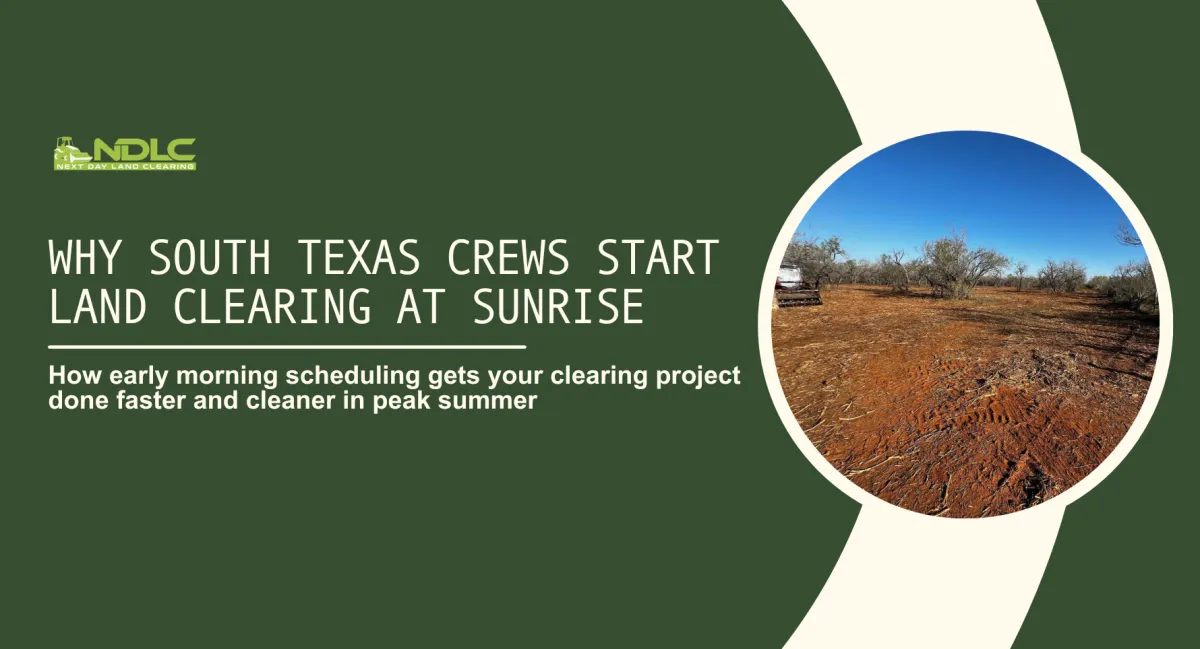
Why South Texas Crews Are Starting Land Clearing at Sunrise
August in South Texas does not leave much room for guessing. By nine in the morning the ground is already hot, the air is heavy, and anyone who has spent a summer clearing brush or running equipment on caliche soil knows the difference an early start makes. This year that difference matters even more. Much of South Texas is still working through drought conditions that have carried over from the past several seasons, and dry rangeland does not behave the same way healthy land does when a crew shows up to clear it.
If you have a clearing project sitting on your list, the timing decision you make this month has more effect on the outcome than most landowners expect. This applies whether you are managing a working ranch, prepping a lot for construction, or simply trying to get an overgrown property back under control before fall.
The Hidden Cost of Waiting Out an August Project
There is a common instinct to push land clearing projects to the fall once the heat breaks. For some jobs that patience pays off. For a lot of properties in South Texas right now, waiting has its own cost, and it is worth understanding before you make that call.
Brush and cedar that already look dry and stressed from drought only get drier as August goes on. Rangeland that has been declining under low rainfall does not recover on its own, and the longer overgrown cedar and brush sit on a property, the more they compete with what little moisture is left for grass and native forage. Ranchers evaluating forage productivity this year are already watching every inch of rainfall closely, and clearing out competing brush is one of the few moves that puts more of that moisture back where it belongs.
There is also a practical scheduling reality that has nothing to do with weather. Crews across South Texas get busier as the calendar moves toward fall, when everyone who did wait now wants their property done before the holidays. Projects booked in August often move faster simply because there is more room on the schedule right now. Come October, that same job could be sitting three or four weeks out.
For landowners weighing the decision, it helps to think about what a delay actually costs. A few more months of cedar encroachment means a few more months of lost grazing capacity. A few more months of an overgrown fence line means a few more months of not being able to see where your property actually ends. None of that reverses itself just because the calendar changes.
Why Crews Are Moving Their Start Times Earlier
Ask any experienced operator in this region and they will tell you August work gets scheduled around the sun, not the clock. Skilled land clearing operators know that equipment runs more efficiently in cooler morning temperatures, and the work itself goes faster when a crew is not fighting midday heat on top of the job.
A few things change when a project starts at sunrise instead of midmorning:
Machines handle rock crushing, forestry mulching, and grading with more consistent performance before the heat of the day sets in, since engines and hydraulics both run cooler and steadier in the early hours.
Operators can complete more of the physical, hands on portions of a job, like fence line clearing or debris removal, before the hottest hours hit, which keeps crews sharper through the entire shift instead of slowing down by midafternoon.
Properties near San Antonio and throughout South Texas see less schedule slippage, because morning starts are less likely to get pushed by afternoon heat advisories or the kind of pop up storms that tend to build later in the day.
Crews stay sharper and safer, which shows up directly in the quality of the finished grading and clearing work, not just in how fast the job gets done.
This is not a scheduling gimmick. It is simply working with the climate instead of against it, and it is part of why professional land clearing companies in this region build their summer routes around early starts rather than a standard nine to five schedule. A crew that shows up at daybreak on a hundred acre ranch job is going to get more done, with better equipment performance, than one that rolls in after the heat has already settled in for the day.
For landowners, this also means flexibility on your end helps. If a crew can get on site early and get moving, that project moves faster from start to finish. Being willing to have a gate opened before sunrise, for example, is a small ask that pays off in a faster completed job.
Dry Ground Changes the Calculation This Year
Drought is not new to South Texas, but the current stretch has been long enough that its effects are showing up in very specific ways. Pastures and rangeland across the district have been described as declining, with topsoil and subsoil moisture ranging from very short to only adequate in the best spots. That kind of stress does not just affect grass. It changes how brush, cedar, and dead vegetation behave when a property has gone unmanaged for a season or two.
Overgrown, drought stressed brush becomes fuel. Dense cedar thickets and unmanaged fence lines hold onto dry material that would normally break down or get grazed back under wetter conditions. For landowners with pasture, hunting leases, or property near a creek or draw, thinning that fuel load now is one of the more overlooked forms of problem prevention available this time of year. It is not about reacting to a crisis. It is about not letting a property sit in a condition that makes a bad situation worse later.
This is also the point where a lot of ranch owners start thinking beyond a single clearing job and toward full pasture reclamation. Removing years of cedar encroachment does more than clean up a fence line. It reopens acreage that has effectively been taken out of grazing rotation, which matters a great deal when every acre of usable pasture counts during a drought year. A property that has lost ten or twenty acres to cedar thickets over the past decade is not just harder to look at. It is producing less forage than it should, at a time when forage is already stretched thin.
Landowners who have been watching their forage numbers against their own projections this year are in a good position to see exactly how much clearing overgrown brush would give back to their grazing capacity. That number often makes the decision to clear now, rather than later, an easy one.
What Changes When You Call Early Instead of Waiting
A land clearing quote in 5 minutes sounds like a small thing until you are the one trying to get a project scheduled before summer ends. Fast quoting and next day scheduling exist because landowners do not always have the luxury of waiting weeks for someone to show up, look at a property, and get back to them with a number.
Here is what that speed actually solves for:
You get a real number fast enough to compare against other projects competing for your budget this year, instead of waiting on a callback that may or may not come.
You are not locked into a multi week wait just to find out if a job is even feasible for your property or your timeline.
Fast mobilization means a crew with specialized land clearing equipment can often be on site the next day rather than the next month, which matters when drought conditions make every week of delay more costly.
You keep control of your own calendar instead of a contractor's backlog controlling it for you.
This approach works the same whether the job is agricultural land clearing on a working ranch, construction site clearing ahead of a build, or residential land clearing around a home that has gotten overgrown. The size of the property changes the scope of the work. It does not change how quickly you should expect an answer, or how quickly a crew should be able to mobilize once you say yes.
This is also where a company's track record matters. Landowners looking for a five star land clearing service are usually not just looking for a good final result. They are looking for a company that answers the phone, shows up when it says it will, and treats a next day estimate as a real commitment rather than a marketing line.
Local Knowledge Still Makes the Biggest Difference
Equipment and scheduling only get a project so far. The bigger factor, especially in a drought year, is whether the crew on your property actually understands South Texas terrain.
Caliche soil behaves differently than the softer ground found in other parts of the state, and it takes a specific approach to grade or clear without creating new problems. Cedar removal around San Antonio and the surrounding Hill Country edge requires a different technique than clearing mesquite further south or west, since root systems, density, and regrowth patterns are not the same from one part of the region to the next. A crew that works exclusively in this area day in and day out has already seen the version of your problem that shows up on a hundred other South Texas properties, and that experience shows up in how clean and how fast the job gets done.
This is part of why landowners searching for land clearing in San Antonio or rock crushing services in San Antonio tend to end up working with a company based in the region rather than a crew traveling in from somewhere else. Local operators know which properties tend to have hidden rock just under the topsoil, which pastures flood first when heavy rain does come, and which cedar stands have been building up for years versus which ones are newer growth. None of that is guesswork. It comes from working this specific stretch of Texas season after season.
For a landowner, the practical takeaway is simple. Ask any contractor bidding on your property how much of their work is actually done in South Texas, and how familiar they are with your specific area. The answer tells you a lot about what to expect once the job starts.
A Practical Checklist Before You Schedule
Before locking in a clearing date this month, it helps to walk the property with a few specific questions in mind. A little bit of planning up front keeps the quote accurate and avoids surprises once the crew arrives.
Where is the densest cedar or brush concentrated, and does it sit near a fence line, driveway, or structure that needs extra care during clearing.
Are there low areas or draws where dry brush has built up and could become a fuel concern later in the season if left alone.
Does the site need forestry mulching, rock crushing for rocky caliche soil, or a combination of both, depending on what is actually growing there and what the ground looks like underneath it.
Is this a one time cleanup, or is it the start of an ongoing pasture reclamation plan that will need follow up work in future seasons.
Will grading or site preparation be needed afterward, or is clearing the only step required right now before the property is usable again.
Do you need stump removal as part of the job, or are you planning to leave stumps in place for now.
Is there equipment or vehicle access to the areas that need clearing, or will a crew need to plan around tighter spaces.
Walking through these questions before the crew arrives keeps the estimate accurate and avoids surprises once work begins. It also gives you a clearer picture of whether you are looking at a straightforward brush clearing job or something closer to a full site preparation project.
Signs Your Property Cannot Wait Until Fall
Some situations are worth acting on now rather than filing away for later in the year. If any of the following sound familiar, an August start is likely worth more to you than waiting for cooler weather.
Cedar or brush has grown dense enough that you can no longer see fence lines or property boundaries clearly from the road or from inside the property itself.
Grazing land has visibly shrunk as brush has encroached over the past year or two, and you can point to specific areas that used to be usable pasture.
A stock tank, pond, or low lying area has become harder to access because of overgrown vegetation, making it difficult to check water levels or maintain the area properly.
You are planning a fall build or site preparation project and need the land cleared and graded well before that timeline starts, since construction schedules rarely leave room for a delayed clearing job.
Dry brush has accumulated near structures, equipment, or fence lines in a way that feels like more of a risk every week it sits there, especially with drought conditions showing no clear end in sight.
You have a hunting lease or seasonal use property where overgrown brush is starting to limit visibility, access, or usability heading into fall.
If two or more of these apply to your property, it is a strong signal that this is the month to act rather than the month to plan around.
South Texas landowners do not need to guess at timing. Between the current drought stress on rangeland and the practical advantages of scheduling around the cooler morning hours, August is proving to be a smarter window for clearing than most people assume. Next Day Land Clearing has built its entire model around fast quotes, fast mobilization, and crews who know how to work this climate instead of fighting it. That is the Next Day Difference, and it applies just as much in August as it does any other month of the year.
Ready to take the next step?
Call us today at 210-864-8342 for a FREE estimate and let's discuss your project! Visit Nextdaylandclearing.com for information.
