The Hidden Dangers Lurking in Overgrown South Texas Properties
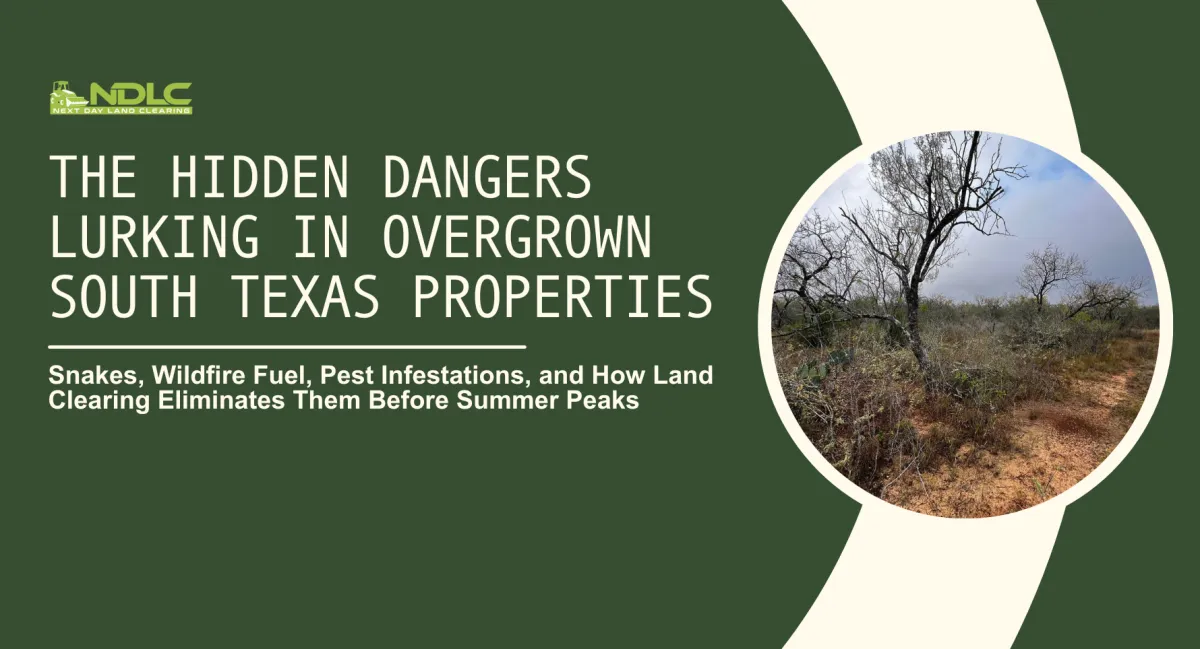
There is a moment every summer when South Texas landowners walk out to a back pasture, a fence line, or a tank dam they have not visited in a few months and realize the property has gotten away from them. The cedar is taller. The mesquite has spread. The understory is a tangled mat of dead leaves, fallen limbs, and prickly growth nobody planted. The path that used to be there is gone.
That growth is not just an inconvenience. By the time June turns into July across San Antonio and the surrounding ranch country, an overgrown property is hosting problems that most owners do not see until something goes wrong. Snakes that should not be near the house. Pest populations that explode in untouched cover. A standing fuel load that turns one careless spark into a wildfire. Each of these risks is real, each of them peaks in the hottest months of the year, and each of them can be reduced or eliminated by getting a handle on the brush before the heat hits its worst.
Here is what is actually living in your overgrown property right now, why summer is when those risks come to a head, and what land clearing does to put the land back in your favor.
The Snake Problem Nobody Talks About Until It Is Too Late
South Texas is rattlesnake country. Western diamondbacks, copperheads, and cottonmouths are all native to this region, and they do not need a wild ranch to be present on your property. They need cover, prey, and a temperature gradient they can manage. Overgrown brush provides all three.
Dense undergrowth, brush piles, tall grass against structures, and unmaintained rock or wood stacks create exactly the kind of habitat snakes are looking for in the summer. They use the cover to stay out of the worst heat, hunt the rodents that thrive in the same conditions, and move along the edges of cleared areas where food is concentrated. The closer that cover gets to your home, barn, or working areas, the closer the snakes get.
The high risk zones on a typical overgrown property:
Brush growing within fifteen to twenty feet of any structure where people walk or work.
Tall grass and weeds along driveways, fence lines, and around equipment storage.
Stacked debris, downed limbs, or wood piles that have been sitting more than a season.
Overgrown stock tank banks and dam edges where snakes find water, prey, and cover all in one spot.
Old equipment, sheet metal, or stored materials that sit on the ground undisturbed.
Clearing brush back from structures, working areas, and high traffic zones is the single most effective thing you can do to reduce snake encounters on your property. It does not eliminate snakes from the land. They have every right to be there. It pushes them away from the places people and livestock spend time, which is where bites happen.
Wildfire Fuel: The Risk That Builds Quietly
South Texas has been in and out of drought for years, and every dry stretch adds another layer to the fuel load sitting on neglected properties. Standing dead cedar. Dried out mesquite branches. Leaf litter that has built up under canopy. Tall grass that cured out weeks ago and is now brittle as paper. None of this burns on its own. All of it burns the moment a spark reaches it.
The math on wildfire fuel is straightforward. The more biomass per acre, the hotter the fire when it ignites. The hotter the fire, the harder it is to stop, and the more damage it does to the soil, root systems, and any improvements in its path. A neglected property does not just put itself at risk. It puts every neighboring property at risk, because that is how fire spreads in brush country: wind, fuel, and a path of dry growth carrying the front from one place to the next.
The fuel sources that matter most on a typical South Texas property:
Standing dead cedar, which holds volatile oils that ignite easily and burn extremely hot.
Mesquite deadfall under live canopy, where dry wood accumulates without breaking down.
Tall cured grass connecting one patch of brush to the next, creating fire ladders across the property.
Brush piles left from past clearing that never got finished or hauled off.
Continuous canopy that allows fire to move from tree to tree without ever touching the ground.
Defensible space is the term used by wildfire professionals to describe the cleared area around structures that gives firefighters a chance to defend the property and keeps a ground fire from reaching the building. On South Texas land, defensible space is not optional. It is the difference between a fire that moves around your improvements and a fire that takes them with it.
How Forestry Mulching Solves the Fuel Problem
One of the reasons traditional brush clearing falls short on fire risk is that it leaves piles behind. Cut and stack works, but the resulting piles are themselves a fuel load until they are burned or hauled off, and burning is not always an option during drought or burn ban conditions. Many properties end up with cleared sections that are technically open but littered with new fuel waiting for the wrong day.
Forestry mulching solves this by grinding standing brush, downed wood, and undergrowth into a fine mulch layer that stays on the ground. The biomass is not removed, but it is restructured into a form that does not carry fire the way standing brush and stacked piles do. The mulch layer also helps retain soil moisture, suppress aggressive regrowth, and protect against erosion when the rains return.
For South Texas properties dealing with cedar, mesquite, huisache, and other aggressive native species, forestry mulching is the cleanest way to knock back the fuel load without creating new fire risk in the process. No burn pile required. No hauling. No waiting for a county wide burn ban to lift before the work can move forward.
The Pest Infestations Hiding in Plain Sight
Snakes get the headlines, but the more consistent pest problem on overgrown South Texas properties is the explosion of smaller species that thrive in untouched cover. Each of these tells you something about the condition of your land, and each of them gets worse the longer the brush is left alone.
Ticks
Ticks need humidity, shade, and a steady supply of hosts. Overgrown brush and tall grass provide all of that. They climb to the tips of grass blades and low branches and wait for something warm blooded to brush past. The denser the cover, the higher the tick population, and the higher the tick borne disease risk for livestock, working dogs, and people walking the property.
Clearing back vegetation to ground level around structures, fence lines, and trails dramatically reduces tick habitat. So does opening up the canopy enough for sunlight and wind to dry out the understory.
Fire Ants
Fire ants prefer undisturbed ground with steady moisture and consistent temperature. Overgrown sections of property are ideal for colony establishment because nothing is moving the soil, nothing is competing for the space, and the surface microclimate stays stable. Clearing the area, even with mulching that leaves a surface layer behind, disrupts the colonies and makes the ground less hospitable for the next wave.
Rodents
Pack rats, deer mice, cotton rats, and other native rodents all thrive in brush. They build nests in the protection of the cover, multiply quickly, and become the prey base that draws snakes onto the property. Reduce the rodent habitat by reducing the brush, and the snake pressure drops behind it.
Mosquitoes
Standing water in low spots, plugged drainages, and overgrown stock tank edges are exactly where mosquitoes lay eggs. The shade and stagnation that come with neglected vegetation make it worse. Clearing the perimeter of water features and grading low spots to drain are both straightforward ways to cut the mosquito load on a property without chemical treatment.
The Compounding Effect Most Owners Miss
Each of these risks is significant on its own. The reason they matter even more together is that they compound. The rodents draw the snakes. The shade holds the ticks. The dead growth feeds the fire potential. The standing water grows the mosquitoes. The longer the property is left to grow, the more the systems reinforce each other, and the harder it gets to deal with any one of them without addressing the others.
Land clearing breaks the cycle. It does not pick off the problems one at a time. It changes the conditions on the property so that all of them get worse for the pests and better for you, at once. A cleared, maintained property is not pest free or fire proof, but it is operating on a different baseline than the property next door that has been left alone for three summers.
What to Prioritize Before Summer Peaks
If your property has gotten ahead of you and you are looking at a long list of issues, here is how to think about the sequence. The goal is to address the highest risk areas first, then expand outward as time and budget allow.
Step One: The Defensible Zone Around Structures
The thirty foot perimeter around any building should be the cleanest, most maintained part of your property. Brush cleared. Grass kept short. No stacked debris within that ring. No tree canopy directly overhanging the structure. This is the zone that matters most for fire defense and for keeping snakes away from doorways.
Step Two: Driveways, Trails, and Access Points
Anywhere people, livestock, or vehicles move regularly should have cleared shoulders. This prevents surprise encounters with wildlife, keeps debris from piling against fences during storms, and creates fire breaks along the routes used most. Cleared access also speeds up emergency response if you ever need it.
Step Three: Fence Lines
Overgrown fence lines do four things at once: they hide deteriorating fence, they collect storm debris that pulls posts down, they create continuous corridors of fuel and cover, and they make every future maintenance task harder. Clearing fence lines back to bare ground is one of the highest value investments a rural landowner can make.
Step Four: High Use Pastures and Working Areas
Pastures that livestock graze regularly, areas where equipment operates, and zones around working pens all benefit from controlled brush reduction. The goal is not bare dirt. It is restoring the balance between native grasses and woody growth so the land remains productive without becoming a hazard.
Step Five: The Back Pasture
The far edges of the property, where livestock rarely go and people almost never walk, can be addressed last. These areas often hold the highest density of cedar and mesquite and provide the most dramatic transformation when finally cleared. They are also where wildfire fuel tends to accumulate undisturbed.
Why Waiting Until July or August Is the Most Expensive Choice
There is a pattern we see every summer in South Texas. Owners notice the problem in May, think about it through June, plan to call in July, and end up scheduling work in August when the heat is brutal, the burn ban is locked in, the wildfire risk is at its annual high, and equipment crews are booked weeks out. By then, the property has already had the worst of the snake activity, the tick season is in full swing, and one nearby spark would have meant catastrophe.
The owners who get the most out of their clearing dollar are the ones who do the work in late spring and early summer, before the conditions get extreme. Equipment works more efficiently in moderate heat. Mulching produces better results when there is still some moisture in the brush. Scheduling is faster because demand has not yet peaked. And the property gets the benefit of cleared conditions through the entire dangerous part of the year, not just the tail end of it.
A Quick Self Assessment You Can Do This Week
Before calling anyone, walk your property with a critical eye. Ask yourself the following questions and answer them honestly:
Can I see bare ground within thirty feet of my house, barn, or shop?
Are my fence lines clear of brush growing up into the wire?
Can a fire truck or work truck access every part of the property without being scratched by overgrowth?
Is there standing dead cedar or accumulated deadfall anywhere on the place?
Are stock tank banks and water features clear of overgrowth and standing dead vegetation?
Is the canopy continuous from one part of the property to another, creating an unbroken fuel path?
Have I been keeping the dogs and kids closer to the house than I used to because of snake concerns?
If you answered yes to more than two of these, the property is past due for clearing work, and the risks are already higher than they should be. The fix is not dramatic, but it does need to happen before peak summer rather than after.
Land Clearing as Property Management, Not a One Time Job
The owners who keep their properties in good shape long term do not think of land clearing as something they do once. They think of it as part of how the property gets managed every year, the same way they think about fence repair, well maintenance, or pasture rotation. A property that was cleared three years ago and has been allowed to grow back unchecked is, in most cases, in worse condition than one that was never cleared at all, because the new growth comes back denser and harder to manage.
Maintenance clearing on a regular schedule, every two to four years depending on the species and growing conditions, keeps the property in functional shape without requiring the bigger, more disruptive jobs that come from neglect. It also lets the native grasses establish and persist, which is the long term goal for productive, healthy South Texas land.
Getting It Done Before Things Get Worse
The hidden dangers on overgrown South Texas land are not exotic. They are the predictable result of leaving the land alone in a climate that grows brush aggressively and dries out hard. Snakes, ticks, fire ants, rodents, mosquitoes, and wildfire fuel are all responding to conditions that can be changed.
Clearing is how you change them. Done well, with the right equipment and operators who understand how this land works, it transforms a property from a liability back into the asset it should be, before peak summer brings the worst of everything to your doorstep.
Ready to take the next step?
Call us today at 210-864-8342 for a FREE estimate and let's discuss your project! Visit Nextdaylandclearing.com for information.
