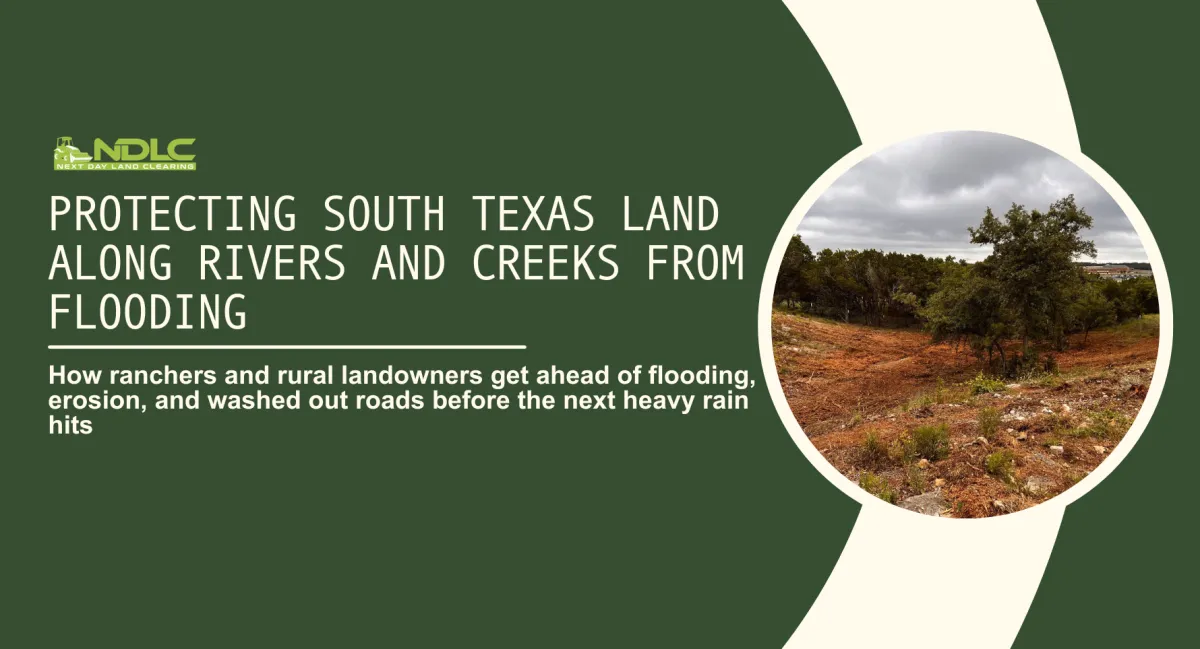
Protecting South Texas Ranch Land Along Rivers and Creeks From Flooding
Here is the full length Aug 20 blog, expanded into range.
Protecting South Texas Ranch Land Along Rivers and Creeks From Flooding
Anyone who owns land along a river, creek, or draw in South Texas has learned the same lesson the region teaches over and over. Water is the most valuable thing you have and the most destructive, sometimes in the same season. This year has driven that home. Long stretches of drought have left ground hard and slow to absorb, and when heavy rain does come, it comes fast and in volume. Land that spent months bone dry can find itself moving water it was never shaped to handle.
For ranchers and rural landowners, that swing between too little water and too much is not a rare event. It is the pattern. And the properties that come through it best are the ones that were prepared before the rain, not scrambling after it.
Why Dry Ground Makes Flooding Worse
It seems backward at first. You would think a long drought would leave the ground thirsty and ready to soak up whatever falls. In practice, the opposite is often true.
When soil goes without moisture for an extended period, it compacts and hardens. Caliche soil, common across South Texas, is already dense and slow to drain. Add months of drought on top of that and the ground behaves almost like pavement when the first heavy rain arrives. Instead of soaking in, water runs across the surface, gathering speed and volume as it moves toward the lowest point on your property.
That runoff is where the damage happens. Fast moving surface water cuts into topsoil, carves new channels through pasture, undermines fence lines, and washes out the access roads you depend on to move around your own land. The drier the preceding season, the worse that first big rain tends to hit.
Understanding this is the first step, because it changes when you act. The work that protects your property is done during the dry stretch, not during the storm.
Where Water Actually Goes on Your Property
Before you can manage water, you have to know how it moves across your specific piece of land. Every property has a natural drainage pattern, and most landowners know theirs better than they realize from years of watching where puddles form and where the grass stays green longest.
A few things are worth walking and mapping out before the next wet stretch:
The lowest points on your property, where water naturally collects and sits after a rain.
The creeks, draws, and drainage paths that carry water off your land, and whether they are clear or choked with brush and debris.
The high traffic areas like driveways, access roads, and gates that turn to mud or wash out when water moves through them.
The location of structures, barns, pens, and equipment storage relative to those water paths.
Any spots where you have seen new erosion or channeling appear over the past couple of years, which are signs that runoff is already reshaping your land.
Once you can see the pattern, the problem areas usually become obvious. Water is predictable. It goes downhill and it follows the path of least resistance. The goal of any drainage work is to make sure that path is one you chose, not one a flood carved for you.
Clearing Creeks and Drainage Paths Before They Back Up
One of the most common and most preventable causes of flooding on rural property is a blocked drainage path. Creeks, draws, and culverts that are choked with overgrown brush, fallen limbs, sediment, and years of accumulated debris cannot carry water the way they were meant to. When a heavy rain hits, that water backs up behind the blockage and spreads out across your land instead of flowing through and off of it.
Clearing these paths is straightforward work that pays off the first time the weather turns. It involves removing the brush and vegetation crowding the banks, pulling out fallen debris and built up material, and reopening the channel so water has a clear route to travel. On many properties, a creek or draw that has not been maintained in years is carrying a fraction of the water it could, and that lost capacity is exactly what shows up as flooded pasture during a downpour.
Fence line clearing plays a role here too. Fence lines that run across or near drainage paths tend to catch debris during high water, turning into accidental dams that make backups worse. Keeping them clear reduces the number of places water can snag and pool.
The key point is timing. This is dry season work. Trying to clear a debris choked creek during or right after a flood is dangerous, slow, and far less effective than getting ahead of it while the ground is firm and the channel is accessible.
How Land Grading Redirects Water Where You Want It
Clearing drainage paths handles the water that is already channeled. Land grading handles everything else, the broad surface runoff that moves across open ground before it ever reaches a creek.
Grading is the process of shaping the surface of your land so water moves in a controlled, intentional direction. Done well, it steers runoff away from the places you want to protect and toward the places that can handle it. A properly graded property directs water off of driveways and access roads instead of down them, away from structures and pens instead of into them, and toward drainage paths, ponds, or lower ground where it can collect or move off safely.
This is some of the highest value work a landowner can invest in, because it addresses the root of the problem rather than the symptoms. Instead of repairing the same washed out road after every storm, you reshape the ground so the water never runs down it in the first place.
Grading also works hand in hand with other site preparation. If you are already planning to clear land, build a pad for a structure, or prepare a site for construction, folding drainage and grading into that same job is far more efficient than treating it as a separate project later. The crew is already on site with the equipment. Getting the water management right at the same time saves you a return trip and a second bill.
Protecting Access Roads and Driveways From Washout
Ask any rural landowner what a flood costs them and access roads come up fast. A washed out driveway or ranch road is more than an inconvenience. It can cut you off from parts of your own property, block equipment and livestock movement, and turn into a repeated expense you pay after every serious rain.
Roads and driveways are especially vulnerable because they are often the smoothest, most compacted surface on a property, which makes them a natural channel for water once it starts moving. Without the right shaping, a road becomes the path of least resistance, and every storm carves it a little deeper.
The fixes are well understood and worth building in before the damage repeats:
Crowning the road surface so water sheds to the sides instead of running straight down the middle.
Cutting proper drainage ditches or bar ditches alongside the road to carry water away.
Installing or clearing culverts at low crossings so water passes under the road rather than over it.
Grading and reinforcing the roadbed with the right material so it holds up under both traffic and water.
Done together, these steps turn a road from a liability into something that survives the wet season intact. For properties that depend on reliable access, whether for daily ranch work, a hunting lease, or a commercial operation, this is some of the most practical drainage work available.
Controlling Erosion and Protecting Your Topsoil
Flooding does not just move water. It moves soil. And on a working property, topsoil is not something you get back easily once a flood carries it off.
Erosion is the slow, expensive cost of unmanaged runoff. Every heavy rain that runs unchecked across bare or poorly shaped ground strips away the productive top layer of soil, the exact layer your grass, forage, and native vegetation depend on. Over years, that loss shows up as thinning pasture, exposed rock and caliche, and channels cutting deeper into ground that used to be productive. In a drought year, when you are already fighting to keep forage viable, losing topsoil to erosion is a double hit.
Controlling erosion ties directly into the other work already covered. Grading shapes the ground so water moves at a manageable speed instead of gathering into destructive, fast moving runoff. Clearing and maintaining drainage paths keeps water in defined channels instead of letting it spread and scour across open pasture. Keeping ground vegetated where possible holds soil in place, which is one more reason that reclaiming overgrown land and managing brush is not separate from water management. It is part of the same system.
The properties that hold their soil through the wet years are the ones where water was given a controlled place to go. The ones that lose ground, sometimes literally, are the ones where runoff was left to find its own way.
Rebuilding and Protecting Ponds and Stock Tanks
For many ranchers, ponds and stock tanks are the whole reason water management matters. They are how you hold water through the dry months, and in a drought year they are among the most important features on the property.
Heavy runoff affects them in two ways. It can fill them with sediment and debris washed down from higher ground, reducing how much water they hold right when you need capacity most. It can also overwhelm and damage them if they were not built or maintained to handle a sudden surge.
A few things keep tanks and ponds working the way they should:
Clearing sediment and accumulated debris that has washed in and reduced holding capacity over time.
Making sure the access to your tanks stays open, so overgrown brush does not keep you from checking and maintaining them.
Shaping the surrounding ground so runoff feeds the tank in a controlled way rather than eroding its banks.
Reinforcing and reworking berms and edges that have worn down over the years.
Well maintained tanks do double duty. They capture and hold the water you need during drought, and they give heavy runoff somewhere useful to go during a downpour. That is the balance every rural property in this region is trying to strike.
A Practical Checklist Before the Next Heavy Rain
Getting ahead of flooding does not require guesswork. Walk your property with these questions in mind and the priorities usually sort themselves out.
Are your creeks, draws, and culverts clear, or are they choked with brush and debris that will back water up.
Do you know where water collects and where it runs during a heavy rain, and are those paths ones you chose.
Are your driveways and access roads graded to shed water, or do they turn into channels every time it storms.
Are your structures, pens, and equipment storage protected from the direction water actually moves.
Have your ponds and stock tanks filled with sediment, and is the access to them still open.
Have you seen new erosion or channeling appear recently, signaling that runoff is already reshaping your land.
Anywhere you answered in a way that gives you pause is a place worth addressing before the next wet stretch, not after.
Why This Is Dry Season Work
The single most important thing to understand about flood protection is that it is done ahead of time. Once water is moving, your options narrow fast. Ground is soft, access is limited, and the same drainage paths you need to clear are full and dangerous to work in.
The dry season, even in the middle of a drought, is exactly when this work should happen. The ground is firm enough to bring equipment across. Creeks and draws are accessible and empty enough to clear properly. Grading holds because you are shaping dry, stable ground rather than mud. Every bit of drainage work you do during a dry stretch is work that is standing ready the moment the weather turns.
South Texas is going to keep swinging between dry and wet. That is the nature of this land. What you can control is whether your property is shaped to handle both. Next Day Land Clearing works with ranchers and rural landowners across the region on exactly this kind of preparation, from clearing debris choked creeks and drainage paths to grading, pond and tank work, and full site preparation. Fast quotes and next day scheduling mean you can get ahead of the problem while the ground is still dry and the window is still open. That is the Next Day Difference.
Ready to take the next step?
Call us today at 210-864-8342 for a FREE estimate and let's discuss your project! Visit Nextdaylandclearing.com for information.
